
AI in Quebec: What the 2025 figures tell us about our new digital reality

Audio summary of the article

1. Introduction: The shift towards an augmented province
Just two years ago, artificial intelligence (AI) was still considered a laboratory curiosity or a gadget for tech enthusiasts. Today, its deployment in Quebec no longer resembles a simple technological evolution, but rather a genuine genetic mutation of our digital landscape.
; a fundamental shift that is radically transforming our relationship to work and information.
It is no longer a tool that we observe with circumspection; it is a force that has nestled itself in the heart of our most mundane routines.
But are we truly aware that AI has gone from being in the shadows to being omnipresent in the daily lives of the majority of Quebecers without us having had the time to define the rules of the game?

2. The majority threshold has been crossed (Adoption surges)
The year 2025 marks a historic turning point: with a spectacular leap, the rate of AI adoption by the Quebec population has gone from 33% in 2024 to 52% this year.
This shift beyond the 50% mark represents a major societal turning point; technology is moving from being an optional choice to a prerequisite for social and professional participation. At this stage of penetration, AI is no longer simply assisting pioneers; it is becoming the structuring standard of our collective productivity.
"By reaching the age of majority, AI in Quebec is ceasing to be a mere technological curiosity and becoming a fundamental pillar of the province's digital culture."
3. The generation gap: A two-speed Quebec
Beneath the veneer of this widespread adoption lies a stark divide, revealing a two-speed Quebec. The data exposes a gaping generational divide: the adoption rate soars to 71% among those under 55, while it stagnates at a mere 25% among those 55 and over. This 46-percentage-point gap is alarming for labour market cohesion.
Beyond simple technical mastery, the real risk is that of an erosion of the value of experience: if seasoned workers do not appropriate this lever of performance, their institutional knowledge risks being eclipsed by the surgical speed of execution of younger colleagues, massively augmented by AI.

4. ChatGPT: The undisputed king of the Quebec market
The Quebec AI market is not a diverse ecosystem; it's a hegemony. A single player crushes the competition, to the point where, in the collective mind, AI has become synonymous with ChatGPT. This dominance raises questions about the emergence of an "algorithmic monoculture" where the logic and writing style of Quebecers are shaped by the biases of a single model.
Here are the market shares of the tools in 2025:
ChatGPT: 84%
Copilot: 29%
Gemini: 22%
Grok: 3%
Claude: 1%
5. From curiosity to habit: AI becomes part of everyday life
AI is no longer a toy to be tested out of boredom, but a routine tool. The frequency of use testifies to a deep integration into our automatic habits: weekly use has increased from 38% to 54% , while daily use has climbed from 11% to 18% .
Although this last figure may seem modest, it represents a relative increase of 63% in one year. This is the most convincing indicator of the end of the gadget era: AI is now an essential cog in the daily machinery of Quebec life.
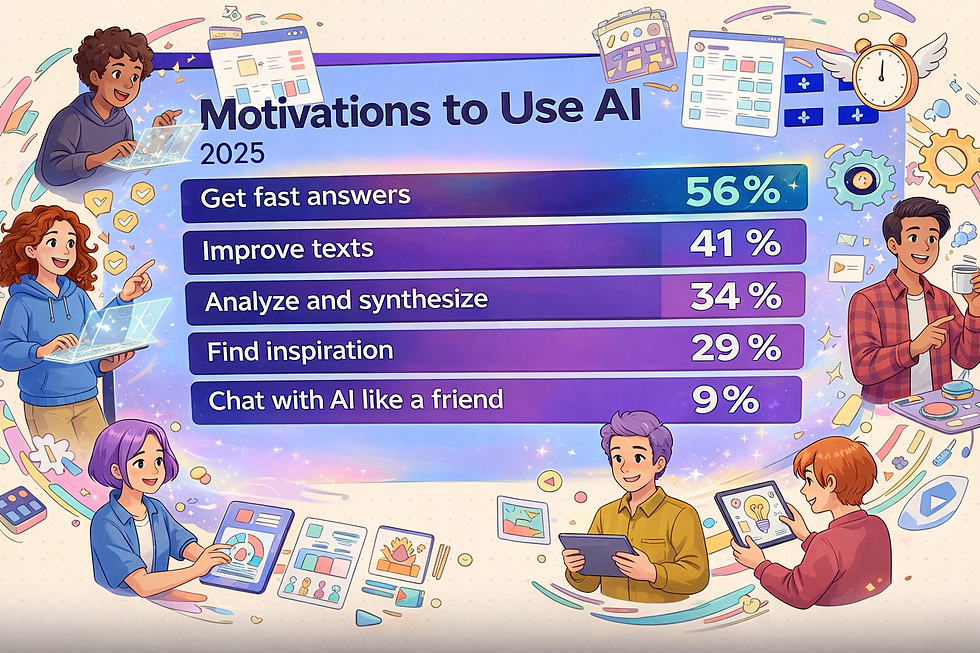
6. Why we use it: Efficiency before friendship
For Quebecers, AI is a purely functional performance lever, not a social substitute. The motivations identified in 2025 confirm this pragmatic approach, prioritizing time savings over emotional connection:
Getting quick answers (56%)
Improving texts (41%)
Analysis and synthesis (34%)
Finding inspiration (29%)
Conversing with AI like a friend (9%)
The verdict is clear: with a marginal score for "friendly" conversation, AI is perceived as a utilitarian assistant. We're not looking for a confidant, but an engine of efficiency.

7. The wallet dilemma: We love it, but we don't want to pay
Despite the perceived added value, cultural resistance to the monetization of digital services remains fierce in Quebec. Although the proportion of citizens willing to open their wallets has increased from 18% to 24% , an overwhelming majority of 67% still refuse to pay for these tools in 2025.
However, there is a slight erosion of this resistance (they were 70% in 2024), suggesting that usefulness is finally shaking up the "everything free" culture on the web, even if the path to a sustainable business model remains difficult.
8. Conclusion: Towards a 100% welfare-dependent Quebec?
By 2025, AI will have officially completed its conquest of Quebec, driven by an unprecedented quest for productivity. If the current trajectory continues, it is highly likely that we will surpass the 70% adoption mark as early as 2026.
While we already delegate the writing and synthesis of our thoughts to these algorithms, a fundamental question arises: how far will we go? Are we ready to sacrifice our critical judgment on the altar of surgical efficiency, and what place will remain for human intuition in a Quebec where every decision will be assisted by a statistical probability?


Comments