
Digital Strategies 2026: 7 Surprising Truths to Propel Your SME


The year 2026 marks a paradoxical turning point for Quebec business leaders. On the one hand, the global market for customer relationship management (CRM) software has reached $71.5 billion, part of a global digital transformation estimated at $0.79 trillion. On the other hand, the reality on the ground remains stark: 43% of organizations are not using their tools to their full potential.
Faced with over 200 options and the definitive end of third-party cookies—signaling the death knell for the era of "leased logistics" in favor of proprietary technology—SME leaders find themselves up against a wall of complexity. How can this chaos be transformed into a driver of growth? Success no longer lies in accumulating tools, but in orchestrating seven fundamental truths that redefine business performance.

1. The multichannel approach: The response multiplier (3.5x)
Relying solely on email for prospecting is now a doomed strategy. By 2026, inbox saturation will make it virtually impossible to cut through the digital noise with a single channel. Data from La Growth Machine confirms that a synchronized LinkedIn + Email approach generates 3.5 times more responses than a standalone campaign.
This transition is no longer a luxury, but a necessity to preserve your digital assets. However, automation carries significant security risks. To protect your account, using cloud-based solutions is essential: they reduce the risk of being banned from LinkedIn to less than 0.1%, unlike browser extensions that expose your profile to immediate detection by security algorithms.
" Sales uses HubSpot, support uses Zendesk, and finance uses another tool: it's a real nightmare. We need ONE system that works. " — This heartfelt cry from a manager illustrates the urgency of moving from fragmentation to a unified platform capable of managing all touchpoints.

2. First-hand data: The end of "zombie cookies"
The era of reliance on third-party cookies is officially over. In 2026, relying on external data is akin to chasing "ghost signals"—imprecise and often invalid. The strategic priority has shifted to enriching first-party data.
Enrichment involves merging your internal information (emails, history) with authorized databases to create a 360-degree customer profile. This approach is the essential fuel for your performance.
Feeding AI algorithms: Google and Meta require high-quality signals (job titles, real purchase intent) to optimize your cookie-free ads.
Maximize retention: In a market where acquiring a new customer now costs 10 times more than retaining an existing one, precise segmentation becomes your best insurance policy.
Sovereignty: Owning your own data is the only way to free yourself from the policy changes of the web giants.

3. From assistant AI to "agentic" AI: The new co-pilot
We are taking a crucial step: the transition from classic generative AI (which responds to commands) to agentic AI. These agents act autonomously to achieve a goal: qualifying leads, detecting stagnant opportunities in your pipeline, or managing inventory without constant human intervention.
The adoption of generative AI has jumped from 55% to 78% in the last 12 months. However, remember that first-hand data (Truth #2) is the only fluid that allows these agents to function effectively. Without high-quality, first-party data, your AI agents are nothing more than engines running idle.
“Redesign, don’t automate.”
As Gartner points out, automating a failing process only accelerates failure. SMEs in 2026 must first rethink their workflows before injecting this autonomous intelligence.

4. The death of traditional SEO in favor of GEO
Search engine optimization (SEO) is undergoing its biggest transformation since the invention of search engines. We are moving from SEO to GEO ( Generative Engine Optimization ). Systems like Perplexity or ChatGPT no longer provide links, but direct summaries.
To be cited by AI, your SME must now monitor advanced technical metrics:
Site Focus Score: The thematic coherence of your domain.
Information Gain Score: The ability of your content to provide unique information not found elsewhere on the Web.
The strategy is no longer about expansion, but about consolidation: merging your redundant content into "authority pillars" reduces the number of pages by 10% while increasing traffic by 55% thanks to strengthened relevance signals.

5. Employee productivity: The new number one priority
A major shift has occurred: for the first time, improving employee productivity surpasses customer experience (CX) as the primary objective of digital transformation.
In a context of particularly acute labor shortages in Quebec, AI and automation are no longer just about increasing sales, but about operating more effectively with existing talent. Leaders realize that well-equipped teams are the necessary foundation for fulfilling any customer promise. Currently, 9 out of 10 organizations are facing shortages of critical AI and cybersecurity skills, making internal training an investment as vital as technology acquisition.

6. Preemptive cybersecurity: Blocking AI with AI
SMEs are the preferred targets of cybercriminals using AI to generate undetectable phishing attacks , responsible for 60% of intrusions in 2026. Cybersecurity is no longer just a matter of defense, it is the guarantor of your productivity (Truth #5): a successful attack instantly reduces your operational efficiency to zero.
Resilience rests on two non-negotiable pillars:
Multi-factor authentication (MFA): An absolute barrier for all cloud access.
The "3-2-1" resilience rule: 3 copies of your data, on 2 different storage media, and absolutely 1 offline copy . This offline copy is your only real protection against ransomware capable of infecting your online backups.
7. Social networks as search engines
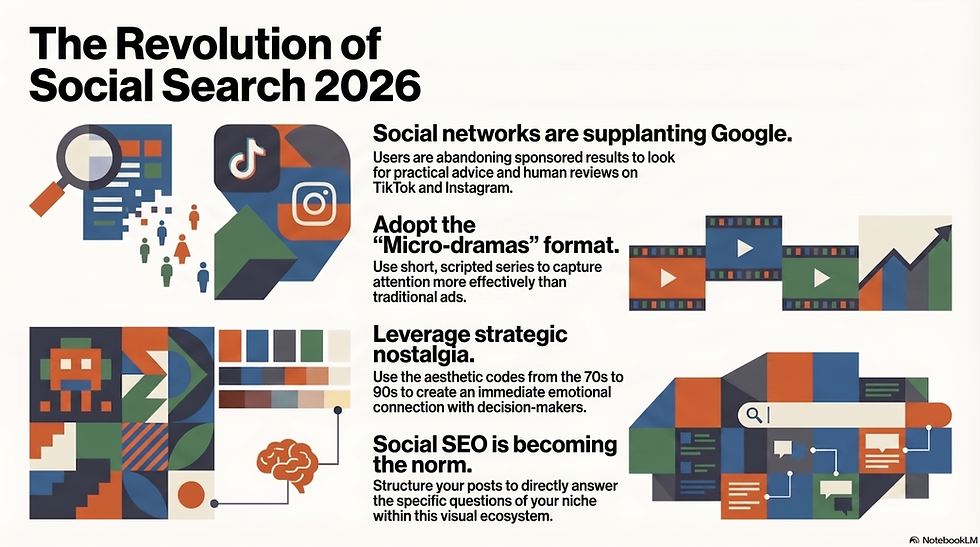
TikTok and Instagram have overtaken Google for finding practical advice and authentic reviews. Users are abandoning sponsored results in favor of real-life human experiences.
For SMEs, two trends dominate:
Micro-dramas: Short, scripted series that capture attention much better than traditional advertisements.
Strategic Nostalgia: Using aesthetic codes from past decades (70s-90s) to create an immediate emotional connection with decision-makers.
"Social SEO" is becoming the norm: your posts must be structured to directly answer questions in your niche in order to become visible in this visual and conversational search ecosystem.
--------------------------------------------------------------------------------
Conclusion
Digital success in 2026 depends not on adopting a miracle technology, but on rigorous orchestration. Performance arises from the synergy between agent-based intelligence, mastery of your proprietary data, and digital trust protected by proactive security.
As you plan your next investments to strengthen your technology assets, ask yourself this fundamental question: Is your current infrastructure a growth engine or a technology debt that is holding back your talent?


Comments