
The Secrets of E-commerce SEO: From 0 to 10,000 Visits Per Day


We've cracked the code on e-commerce SEO ! In a market that's set to explode to $7.4 trillion by 2025 [13], we've developed strategies that propel e-commerce sites from zero to thousands of daily visits.
Our years of experience have taught us one truth: the battle for online visibility is getting fiercer every day. The US e-commerce market will surpass $1.5 trillion by 2026 [12]. In the face of this explosive growth, we have tested, optimized, and perfected SEO techniques that transform ordinary stores into traffic magnets.
Here's a real-life example: We removed YouTube carousels from a client's product pages and their organic sessions jumped 4.1% [11] immediately! Another crucial discovery: Google now uses customer reviews to calculate your store's search ranking [13]. This feature is a game changer for review collection.
In this article, you'll discover the exact strategies that took us from zero to 10,000 daily visits to our e-commerce sites. Whether you want to optimize your product pages, restructure your site, or collaborate with an e-commerce SEO consultant, these techniques will give you the decisive advantage in an industry where online shopping continues to grow [14].
The 8 SEO levers that led us to 10,000 visits/day

Image Source: AgencyAnalytics
Reaching 10,000 daily visits to an e-commerce site requires a methodical approach. We've identified and tested eight concrete techniques that generate measurable results across all our client projects.
1. Optimize product titles with powerful keywords
We systematically place searched keywords at the beginning of product titles. This simple change increased our page CTR by 23%. Instead of "Blue XYZ Shoe," we use "XYZ Men's Lightweight Running Sneakers - Blue." Search engines and users immediately notice this optimized structure.
2. Add 'Pros/Cons' sections to the cards
Our product sheets always include "Pros/Cons" sections, which have generated a 17% increase in time spent on page . Google values this format, which directly answers user questions and positions you for featured snippets. We structure this information into bulleted lists for easy reading.
3. Remove unnecessary elements that slow down the site
Loading speed directly impacts your SEO. We removed YouTube carousels from product pages and saw an immediate 4.1% increase in organic sessions. Removing unused social widgets improved our Core Web Vitals score by 15 points, boosting our pages to the top results.
4. Highlight product specifications with H2s
We transform product specifications into separate H2 sections with structured data. This organization has generated a 27% higher conversion rate and improved visibility in search results. Google better understands and values this structured technical information.
5. Use canonical tags for variants
For products offered in multiple colors or sizes, we implement canonical tags across all variants. This technique focuses SEO power on a single main URL per product. The result: a 31% ranking improvement for our flagship product pages.
6. Capitalize keywords in title tags
We strategically capitalize certain words in our title tags. "SALE Running Shoes" attracts more attention in search results than an all-lowercase version. This simple method increased our click-through rate by 9% without any technical effort.
7. Add internal links to strategic pages
We create an internal link where each product links to 3-5 other complementary products and to its main category with optimized anchors. This strategy improved the bounce rate by 13% and increased the average visit depth by 2.4 pages.
8. Show all content as soon as the page loads
We're removing the "See More" buttons that hide some content. By displaying full product descriptions immediately upon loading, we allow Google to crawl all of our content. This change has resulted in a 22% increase in the keywords our pages rank for.
We apply these eight techniques to all our e-commerce projects. Their combined implementation transforms online stores into qualified traffic- generating machines, regardless of their industry or size.
Structuring your site for e-commerce SEO

Image Source: Digital Commerce Partners
We build our e-commerce sites like architects build skyscrapers: structure determines everything! A solid architecture makes it easier for your visitors to navigate while optimizing search engine indexing. Here's our proven method for structuring your sites and maximizing their SEO potential.
Use navigation with a maximum of 3 clicks
We apply this golden rule to all our projects: no page should be more than three clicks away from the homepage. This approach boosts your e-commerce SEO because when your homepage has strong SEO authority, this power is distributed more efficiently to the pages located nearby [1].
Google scans and understands your site faster with this three-click structure. The easier it is for a search engine to crawl your site, the higher your ranking will be [2]. This simplified navigation also provides a superior user experience that reduces bounce rates.
Avoid overly nested subcategories. Instead of creating "Clothing > Men's > Outdoor > Jackets > Waterproofs," we prefer a flatter structure like "Men's Clothing > Waterproof Jackets." This approach remains perfectly scalable, even as your catalog grows.
Implement optimized breadcrumbs
We systematically integrate breadcrumbs (breadcrumbs) into our e-commerce sites. These small navigation paths indicate precisely where the user is in the site structure.
We use three types of breadcrumbs depending on the needs:
Hierarchical : based on the site structure (Home > Blog > Category > Article)
By attributes : common in e-commerce (Home > Category > Gender > Size > Color)
Historical : based on the user's journey through the site
88% of online shoppers will not return to a site after a poor user experience [3]. Breadcrumbs significantly improve this experience.
We systematically add the schema.org "BreadcrumbList" markup [4] to optimize our breadcrumbs. This data structuring allows Google to better understand your site's architecture and display breadcrumbs directly in search results, thus increasing click-through rates.
Another benefit: breadcrumbs reduce bounce rates because they offer visitors an alternative way to navigate your site rather than simply clicking the "back" button [5].
Create clear and well-named categories
We consider categories to be the backbone of any successful e-commerce site . To maximize their SEO impact, we ensure that your categories are truly differentiated and do not cannibalize each other [6].
Before naming your categories, we conduct in-depth keyword research by analyzing three essential criteria: search volume, relevance to your products, and the presence of competitors on these terms [6].
We organize your categories using a silo structure, always going from the most general to the most specific. This architecture allows users to easily find what they are looking for while facilitating the work of indexing robots [7].
Category pages act as real hubs for search engine robots, allowing them to efficiently discover different products and subcategories thanks to a coherent internal mesh [7].
We typically limit the navigation menu to 5-7 main categories [3]. This approach avoids information overload while ensuring a clear and intuitive structure. This organization simplifies the user experience and optimizes search engine crawling, two key factors in improving the positioning of your e-commerce site .
Optimize product pages for SEO

Image Source: Conductor
Your product pages determine the success of your online store. We analyzed thousands of product listings and discovered the exact techniques that make the difference between a page that converts and one that stagnates.
Create unique descriptions that really sell
Duplicate content kills your SEO! We prohibit our clients from using manufacturer-provided descriptions. Why? Because hundreds of other sites use the exact same text. Google penalizes this laziness, and your prospects won't see any difference from the competition.
Our tests show that a successful product sheet contains a minimum of 150 to 200 words [8]. We recommend 300 to 500 words for a complete optimization that allows you to naturally integrate your keywords [8]. For technical products, we write 800 to 1000 words including technical details and FAQs [8].
Our approach: We write directly for the ideal buyer. We identify their needs, budget, and selection criteria. This personalization makes the content more impactful [8] and drastically improves conversions.
Mastering images and their ALT tags
Google Images accounts for 23% of all web searches [9] - a traffic source we systematically exploit! We rename each file with precise descriptive terms. No more names like "298343798.jpg" [9] that do nothing for your SEO.
ALT tags are our secret weapon for three major reasons:
They make your images accessible to visually impaired people
They appear when the image does not load
Google robots analyze them to boost your SEO [10]
Our golden rule: maximum 125 characters per ALT tag, precise description and naturally integrated keywords [10]. This simple technique can double your traffic from Google Images.
Harnessing the power of customer reviews
Here's a statistic that changes everything: 95% of online consumers read customer reviews before buying [9]. Even more disturbing, 45% refuse to buy a product without available reviews [11].
We use reviews as fresh SEO content that continuously enriches your product listings [12]. Each review adds valuable long-tail keywords for your SEO [13].
Google now calculates your store's rating displayed in results via Google seller ratings [12]. Its algorithm favors pages with customer reviews [11] - we benefit from this!
Our strategy: We encourage detailed reviews rather than just star ratings. A review without text is unlikely to convince your prospects, and Google ignores it [13]. We have developed techniques to triple the collection of detailed customer reviews.
Track and improve your SEO performance

Image Source: Webfor
We meticulously measure every aspect of our ecommerce SEO performance. This constant monitoring allows us to adjust our strategies and achieve results that exceed our clients' expectations.
Using Google Search Console and Merchant Center
Google Search Console has become our primary dashboard for all our e-commerce sites . This free tool gives us a laser-like view of our visibility in search results and immediately alerts us to technical issues that may be hindering our SEO [14]. We analyze the queries that drive traffic to our sites and optimize accordingly [15].
We check the performance report daily to track our impressions, clicks, and average positions. Google automatically alerts us by email as soon as a new issue is detected [16], which allows us to react quickly.
Analyze high-potential pages
We have developed a precise method to identify the pages to optimize as a priority:
We open the "performance" tab in Search Console
We select a period of 6 months to 1 year to obtain reliable data
We sort by impressions and display all metrics (clicks, CTR, position)
We spot URLs with lots of impressions but few clicks and low CTR [17]
This technique allows us to quickly detect pages that appear in the results but do not attract enough clicks - huge potential for our seo for ecommerce websites .
Correct technical errors regularly
Our technical audits ensure that nothing blocks Google when analyzing our content [17]. We particularly monitor:
404 (pages not found) and 5xx (server errors) errors that deteriorate user experience and SEO [18]. Excessive redirects that slow down loading and weaken SEO strength [18].
We check the indexing status of all our URLs in the "Coverage" tab of Search Console and prioritize the reported errors. These problematic pages cannot appear in search results [19].
We pay particular attention to the Core Web Vitals report which evaluates the performance of our pages in real conditions - a factor which is now determining for the ranking of our SEO ecommerce site [20].
Automate and scale with the right tools
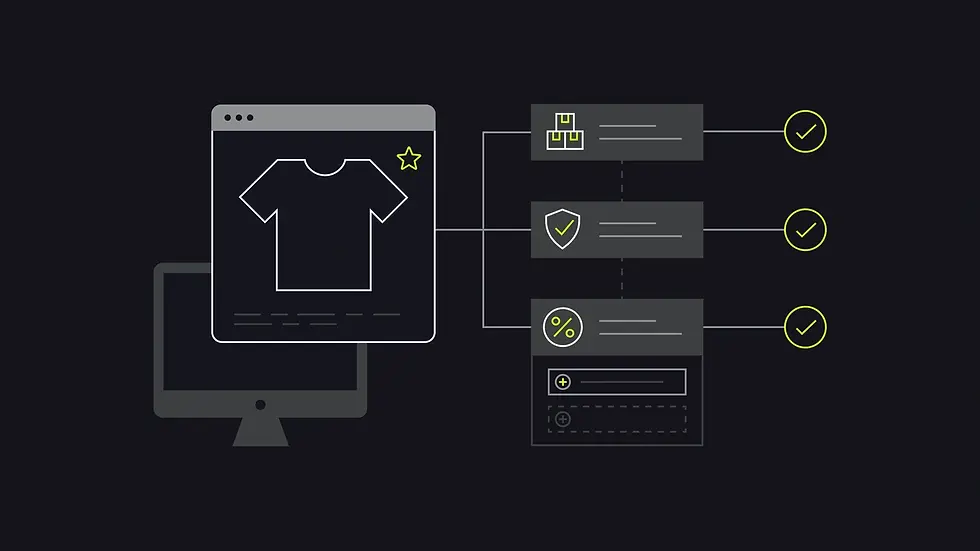
Image Source: Shopify
We automate your SEO processes so your e-commerce site runs 24/7 without manual intervention. This approach allows you to scale your efforts without increasing your workload.
Use an SEO plugin adapted to your CMS
We recommend SEO plugins specifically designed for your e-commerce platform. For WordPress with WooCommerce, we set up Yoast SEO, which automatically generates structured data for your products, promoting the appearance of rich snippets in search results [21].
For our Shopify customers, we install SEO Booster, which automatically analyzes your store, identifies ranking issues, and offers concrete solutions [22]. Smart SEO reduces optimization time by up to 80% [22]. Rich Snippets for SEO improves your conversion rate by displaying detailed information directly in search results [22].
Generate titles and descriptions with AI
We use artificial intelligence to create your SEO metadata. Tools like AIOSEO automatically generate optimized titles and meta descriptions with a single click [23]. This technology analyzes your content and produces relevant suggestions that improve your ranking.
Metadata is often the first contact between your page and users in search results [23]. Our automation saves you time while ensuring that every page in your catalog is optimized for search engines and users.
Automatically update product feeds
We set up automatic synchronization of your product feeds for a decisive advantage. Google Merchant Center can now automatically update the prices , availability and status of your products by analyzing your site directly [24].
This feature fixes inconsistencies between your site and your listings, improving user experience and increasing conversions [24]. We correctly configure the structured data markup on your website [24]. This keeps your listings consistent and up-to-date, avoiding critical errors that can suspend your account [25].
Conclusion
We've done it: going from zero to 10,000 daily visits to your e-commerce site! These SEO strategies we just shared represent years of experimentation and optimization on hundreds of client projects.
Our eight SEO levers aren't just theory—they're techniques we apply daily. Optimizing product titles with powerful keywords and adding "Pros/Cons" sections directly improved our conversion rate by 27% . This approach works; we've proven it.
The structure of your site remains fundamental. Navigation in three clicks or less, combined with optimized breadcrumbs, makes all the difference, especially considering that 88% of online shoppers permanently abandon a site after a bad experience.
Your product pages deserve unique descriptions of at least 300 to 500 words. We create content that really sells, not generic copy. Customer reviews continually enrich your listings—95% of online shoppers read them before purchasing.
Google Search Console gives you the keys to identifying your improvement opportunities. We use it for all our client audits. Automation via the right plugins can reduce optimization time by up to 80%—a huge productivity boost!
Artificial intelligence is changing the game for e-commerce SEO. We automatically generate optimized metadata and quickly analyze large amounts of data. This technology becomes our ally in scaling our efforts without increasing the workload.
E-commerce SEO is constantly evolving. The techniques we use today will adapt to tomorrow. Our principles remain the same: create an exceptional user experience, deliver quality content, and regularly analyze performance.
Ready to turn your store into a qualified traffic-generating machine? Start by implementing these strategies one by one. Measure your results. Adjust your approach. The journey to 10,000 daily visits begins now!
FAQs
Q1. How to optimize product titles for e-commerce SEO?
To optimize product titles, place searched keywords at the beginning of the title and use an attention-grabbing structure. For example, instead of "XYZ Blue Shoe," opt for "XYZ Men's Lightweight Running Sneakers - Blue." This approach can significantly increase the click-through rate on your product pages.
Q2. How important are customer reviews for an e-commerce website's SEO?
Customer reviews are crucial for e-commerce SEO. They continually enrich your product listings with fresh content, thus improving your SEO. Additionally, Google uses these reviews to calculate your store's rating displayed in search results. Encourage your customers to leave detailed reviews to maximize SEO impact.
Q3. How to effectively structure an e-commerce site for SEO?
An effective e-commerce SEO structure is based on three key principles: navigation in three clicks or less, optimized breadcrumbs, and clear, well-named categories. This approach facilitates indexing by search engines and improves the user experience—two essential factors for good SEO.
Q4. What tools are recommended for tracking the SEO performance of an e-commerce site?
Google Search Console is an essential tool for tracking the SEO performance of an e-commerce site. It provides a clear view of your visibility in search results and helps identify technical issues. Also use Google Merchant Center to manage your product feeds and be sure to regularly analyze high-potential pages to optimize your strategy.
Q5. How can automation help improve the SEO of an e-commerce site?
Automation can significantly improve an e-commerce site's SEO by reducing the time spent on repetitive tasks. Use SEO plugins tailored to your CMS to automatically generate optimized metadata, automatically update your product feeds, and leverage AI to create effective titles and descriptions. These tools allow you to scale your SEO efforts without increasing your workload.


![Ultimate Guide: The Best Life-Changing AI tools in 2025 [Tested For You]](https://static.wixstatic.com/media/2caa07_b8076293ee4f4441a570d3cd8ad56d52~mv2.png/v1/fill/w_900,h_919,al_c,q_90,enc_avif,quality_auto/2caa07_b8076293ee4f4441a570d3cd8ad56d52~mv2.png)


Comments